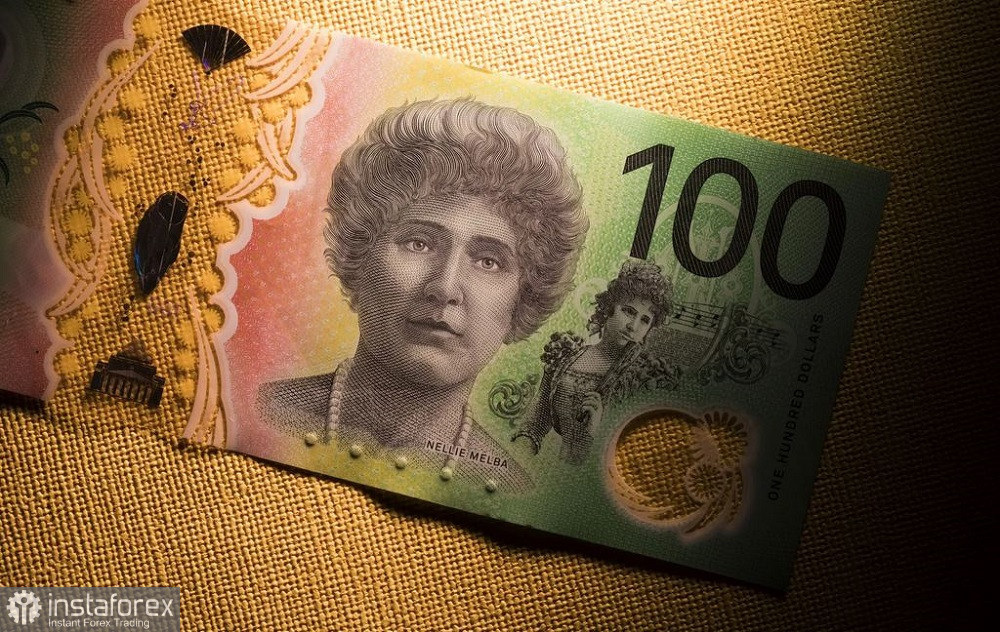
The Australian dollar against the U.S. dollar is approaching the boundaries of the 66 figure while updating local price highs. On Wednesday, the pair tested the resistance level at 0.6590, which corresponds to the upper line of the Bollinger Bands on the D1 timeframe. This is the highest price level since the end of October. It is important to note that the pair is rising not only because the U.S. dollar is weakening but also because the Australian dollar is strengthening. Even the negative figures released on Wednesday on Australian GDP growth could not deter buyers of AUD/USD; bullish sentiment still prevails in the pair.
However, the disclosed report is not as bad as it may initially seem. In quarterly terms, GDP volume increased by 0.4%, while most analysts expected a more significant growth of 0.7%. In the first quarter, the economy grew by 0.3% quarter-on-quarter; in the second quarter, by 0.6%; and in the third quarter, by 0.4%.
Annually, Australia's GDP rose by 2.1%, following a 1.8% growth in the previous quarter. The forecast was 2.2% year-on-year, but the reported result is the strongest in the last two years. Moreover, this indicates sustained economic growth: the indicator has demonstrated an upward trend for four consecutive quarters.
The report's structure indicates strong domestic demand, supported by households, businesses, and government spending. In particular, business investments made a significant contribution—especially in infrastructure and equipment. For instance, private investments increased by 2.9%, the fastest growth rate in nearly five years (since early 2021). An important component was the investment boom in infrastructure and ICT, particularly the construction/expansion of data centers (amid increased demand for cloud and AI services). There was also an increase in housing construction investments.
Government spending played a significant role as well—government investments rose by 3.0%, fueled by a surge in water infrastructure and renewable energy projects.
Household consumption increased by 0.5%. The main drivers of this growth were expenditures on electricity, healthcare, food, and rent.
Overall, the result for the third quarter—2.1% year-on-year—exceeds the two percent trend that the Reserve Bank of Australia (RBA) targets. Despite some slowdown in growth in quarterly terms, the economy maintains steady growth—the fundamentals remain strong. Moreover, increased investments (especially in technological and infrastructure projects) may positively affect future growth potential by expanding production capacities, improving infrastructure, and creating new jobs. This is important, as such structural upgrades provide a more stable driver compared to temporary consumption spikes.
In other words, the market has reasonably interpreted the GDP growth report in favor of the Australian dollar. The economy has shown respectable results amid rising inflation and a tightening labor market. It should be noted that the consumer price index accelerated in October to 3.8% year-on-year (with an expected rise to 3.6%), reaching the highest level since June 2024. Meanwhile, the unemployment rate fell in October to 4.3% (the forecast was 4.4%), and the number of employed increased by 42,000, against a forecast of 20,000. The overall figure grew due to full employment (+55,000).
This fundamental backdrop allows the RBA to maintain a wait-and-see position not only at the December meeting but also at the beginning of the following year.
At the same time, the U.S. dollar came under additional pressure on Wednesday after the ADP report was published. According to this agency's calculations, employment in the U.S. private sector decreased by 32,000 in November. Although ADP data do not always correlate with official numbers, this is a concerning signal indicating that the U.S. labor market is cooling at a faster pace.
After Wednesday's publication, the probability of a Federal Reserve rate cut at the December meeting has increased to nearly 90%, according to CME FedWatch data. The U.S. dollar index has also reached a three-week low, dropping into the 98 range.
Thus, the current fundamental picture for the AUD/USD pair suggests a priority for long positions. The technical analysis indicates the same. On all "higher" timeframes (from H4 and above), the pair is trading between the middle and upper lines of the Bollinger Bands, and on the H4, D1, and W1 timeframes, it is above all Ichimoku indicator lines, with a bullish "Parade of Lines" signal formed on the four-hour chart. It is advisable to consider long positions on corrective price dips. The first target for the upward movement is at 0.6590 (the upper line of the Bollinger Bands on the D1 timeframe). By surpassing this price barrier, buyers of AUD/USD will open the path to the next resistance level at 0.6640, which corresponds to the upper line of the Bollinger Bands on the weekly chart.